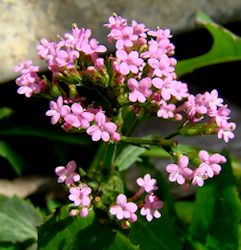
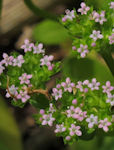
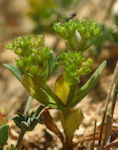
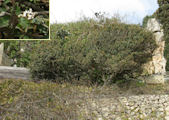
Family Description: Caprifoliaceae, commonly known as the honeysuckle family, is a diverse group of flowering plants in the order Dipsacales, comprising about 42 genera and nearly 890 species. It is primarily distributed across the Northern Hemisphere, especially in temperate regions, with some species extending into tropical montane zones.
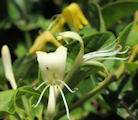
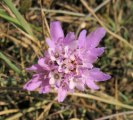
Members range from woody shrubs and vines (Lonicera, Symphoricarpos) to herbaceous perennials (Valeriana, Scabiosa). Leaves are typically opposite, simple or compound, and exstipulate, often with entire or toothed margins. Some species, like Lonicera japonica, are twining climbers with papery bark and prehensile petioles.
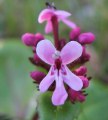
Flowers are usually zygomorphic or actinomorphic, bisexual, and pentamerous, with a gamopetalous corolla that is tubular, bell-shaped, or funnel-like. The calyx is small and persistent, and the ovary is inferior, typically 2- to 5-locular with axile placentation. A nectary disc is often present at the base of the style.
Fruits vary from berries and drupes (Lonicera, Symphoricarpos) to achenes and capsules (Scabiosa, Valeriana), often with persistent sepals that aid in dispersal. Seeds are usually endospermic, with a straight embryo.
Family Description: Herbaceous or woody plants. Leaves alternate, simple, linear, oblong or lanceolate, exstipulate, deciduous or evergreen. Flowers small, hermaphrodite or unisexual. Perianth 3- to 5-lobed or -partite, tubular to campanulate-rotate. Stamens 3-5, opposite lobes of the perianth. Ovary inferior, 1-celled. Style 1; stigma capitate or lobed. Fruit a small green nut or a drupe. Seed solitary, with abundant endosperm. Hemiparasites, growing on the roots of herbs or shrubs.