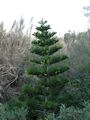
Family Description: Araucariaceae is an ancient family of coniferous gymnosperms within the order Araucariales, comprising three extant genera: Araucaria, Agathis, and Wollemia. These trees are primarily distributed in the Southern Hemisphere, with notable centers of diversity in Australasia and South America. Fossil records indicate a much broader distribution during the Mesozoic era.
Members are typically large, evergreen trees, often reaching heights of 30 to 60 meters, with columnar trunks and whorled, horizontal branching. The leaves are spirally arranged and vary from needle-like to broad and flattened, often with parallel venation and persistent on the branches for many years.
The family is mostly dioecious, though some species are monoecious. Male cones are cylindrical and pendulous, composed of numerous spirally arranged microsporophylls bearing multiple pollen sacs. Female cones are large, erect, and globose to ovoid, with woody bract-scale complexes, each typically bearing a single large seed. Seeds are often winged and dispersed by wind or gravity.
Wood anatomy features large resin canals and a relatively uniform tracheid structure. These trees are ecologically significant in rainforest and montane habitats and are often dominant canopy species.
Family Description: Cupressaceae, commonly known as the cypress family, is a diverse and widespread group of coniferous, evergreen trees and shrubs in the order Pinales. It includes about 30 genera and 130–140 species, with members ranging from towering redwoods to compact junipers. These plants are found across a wide range of habitats—from arid deserts to temperate rainforests and high mountain slopes.
Most species are monoecious, though some are dioecious or subdioecious. The leaves vary with age: young plants often bear needle-like leaves, while mature individuals typically have scale-like leaves arranged in spirals, opposite pairs, or whorls. These leaves are usually evergreen and persist for several years, though a few genera like Taxodium and Metasequoia are deciduous.
Seed cones are highly variable: they may be woody, leathery, or fleshy (as in Juniperus), and their scales are typically fused with the bract scale, often forming a visible umbo. The seeds are usually small, flattened, and winged, although some genera produce wingless seeds. Pollen cones are more uniform—small, often clustered, and bearing spirally or oppositely arranged scales.
The family includes some of the tallest and longest-lived trees on Earth, such as Sequoiadendron giganteum (giant sequoia) and Sequoia sempervirens (coast redwood). Economically, Cupressaceae provides timber, ornamental trees, essential oils, and resins.
Sandarac gum tree, Mediterranean alerce, Arar tree
Siġra tal-Għargħar, Għargħar
All year
Normal Profile with
images.
CYCADACEAE Persoon
Cycad Family
Subfamalies: nil.
Family Description: Cycadaceae is a family of ancient, palm-like gymnosperms in the order Cycadales, with a fossil record dating back to the Mesozoic Era. It includes a single extant genus, Cycas, comprising over 100 species distributed across tropical and subtropical Asia, Oceania, and parts of eastern Africa. These plants are often mistaken for palms or ferns but are evolutionarily distinct and among the most primitive seed plants still living today.
Members of Cycadaceae are typically dioecious, meaning male and female reproductive structures occur on separate plants. They have unbranched or sparsely branched trunks, often with a crown of large, pinnately compound leaves that emerge in whorls. The leaves are leathery, with parallel venation and circinate vernation (they unfurl like ferns).
Male plants produce cones (microstrobili) that bear pollen, while female plants bear megasporophylls—leaf-like structures that are not organized into cones (a key trait distinguishing Cycas from other cycads). These megasporophylls are spirally arranged and bear ovules along their margins. Fertilization is wind- or insect-mediated, and the seeds are large, often brightly colored, and sometimes edible after detoxification.
The stem anatomy is also distinctive, with a large central pith and a narrow zone of soft wood. Many species form coralloid roots that house nitrogen-fixing cyanobacteria, aiding survival in nutrient-poor soils.
Botanical Name
Common Name
Maltese Name
Flowering Period
Thumbnail Picture
Profile Type
EPHEDRACEAE Dumortier
Jointfir Family
Subfamalies: Siphonospermoideae, Ephedroideae
Family Description: Ericaceae, commonly known as the heath or heather family, is a diverse and ecologically significant group of flowering plants within the order Ericales. This family includes over 120 genera and approximately 4,000 species, ranging from low-growing ground covers to small trees. Members are widely distributed across the globe, particularly thriving in acidic, nutrient-poor soils—often in temperate and subarctic regions, as well as mountainous tropical zones.
Morphologically, Ericaceae species are typically woody—either shrubs or small trees—with simple, often evergreen leaves that are alternate, opposite, or whorled, and usually lack stipules. The flowers are usually hermaphroditic and exhibit a wide range of forms, though many share a characteristic urn-shaped corolla formed by fused petals. The floral symmetry is generally radial, though some genera like Rhododendron may show bilateral symmetry. Anthers often open by pores rather than slits, a trait associated with specialized pollination strategies.
The fruits vary across the family, including berries, capsules, and drupes. Economically and horticulturally important members include Vaccinium (blueberries, cranberries), Rhododendron (including azaleas), Calluna (heather), and Kalmia (mountain laurel). Some members, like Monotropa, are mycoheterotrophic and lack chlorophyll entirely, relying on fungal associations for nutrients.
Family Description: Pinaceae, commonly known as the pine family, is an influential group of coniferous gymnosperms within the division Pinophyta. Comprising about 11 genera and roughly 220–250 species, this family includes familiar trees such as pines (Pinus), spruces (Picea), firs (Abies), cedars (Cedrus), larches (Larix), hemlocks (Tsuga), and Douglas-firs (Pseudotsuga). Most members are evergreen, although genera like Larix and Pseudolarix are deciduous, an adaptation to seasonal climates. Their leaves are typically needle-like or, in some cases, scale-like, each modified with a thick cuticle to minimize water loss.
Reproductive structures are equally specialized. Pinaceae are monoecious, bearing distinct male and female cones on the same plant. The female cones are usually woody with spirally arranged scales, each often bearing two ovules, while the male cones, smaller and less conspicuous, release abundant wind-dispersed pollen. Resin production is a common trait, providing a natural defense against pathogens and herbivores. This combination of ancient evolutionary traits, efficient reproductive strategies, and adaptations to cold or dry conditions has allowed the Pinaceae to dominate boreal and montane forests, making them ecologically and economically significant